Top 5 Alumina Continuous Fiber Manufacturers
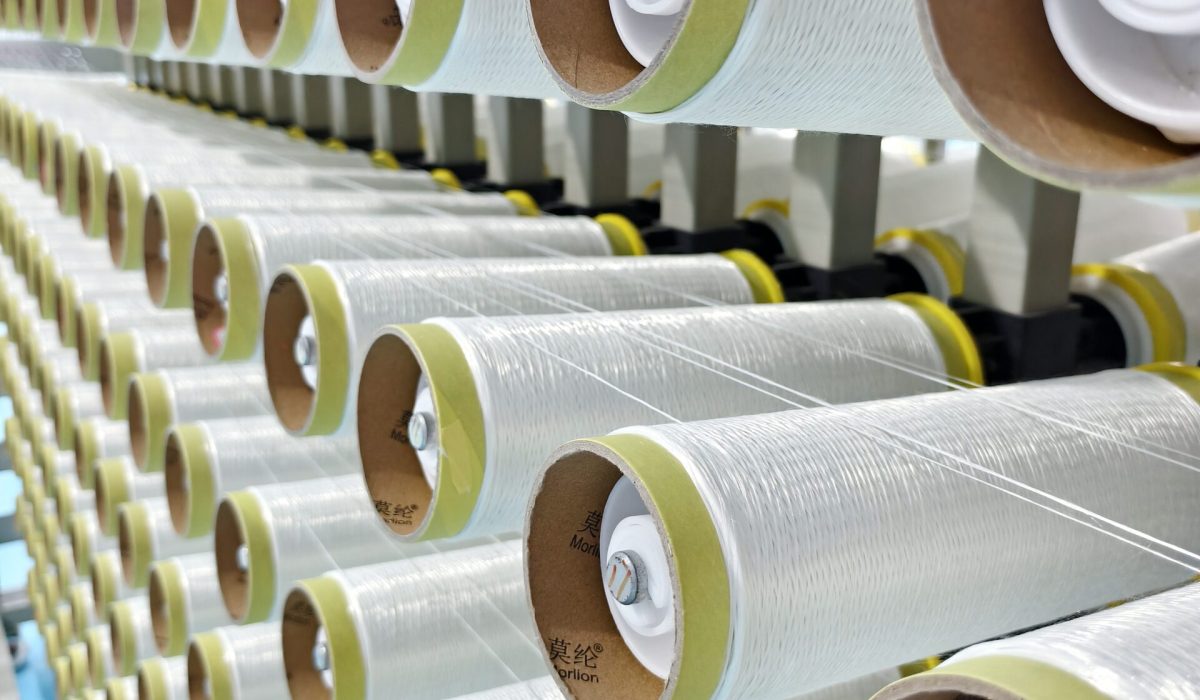
Alumina continuous fiber is the only high-performance fiber that survives oxygen. Carbon fiber oxidizes above roughly 400 °C. Silicon carbide degrades in steam. Alumina filament holds its strength from −270 °C to 1,300 °C in air, and stays flexible enough to weave.
That is why it ends up in jet engine exhaust parts, missile radomes, semiconductor furnaces and battery fire barriers — and why so few companies make it.
What It Is
A polycrystalline ceramic filament made by sol-gel spinning: a spinnable alumina gel is extruded, dried and fired into corundum or mullite crystals.
Diameter: 7–14 µm
Alumina content: 72–99%
Forms: roving, yarn, fabric, tape, sleeving, rope, thread
Main use: reinforcement for oxide-oxide ceramic matrix composites (CMC)
The Five Manufacturers
1. 3M — Nextel (USA)
610 / 720 / 312 · 70–99% Al₂O₃ · 1,000–1,200 °C
The benchmark everyone else is measured against. Nextel 610 is 99% alumina and the strongest grade on the market; Nextel 720 trades peak strength for creep resistance at 1,200 °C. Both have long been export-controlled — which is exactly why Chinese producers exist.
3M Nextel ceramic fiber →
2. NITIVY — ALF (Japan)
ALF / ALCELON · ~72–80% Al₂O₃ · 1,000–1,200 °C
A weaver, not a tow seller. Nitivy moved from PVA dry spinning into alumina and now ships fabric, sleeving, rope and custom parts for semiconductor and aerospace customers. Its 2026 ALCELON grade pushes alumina content higher without losing continuous form.
NITIVY ALF continuous alumina fiber →
3. MORLION (China)
735 / 857 / 896 / 996 · 73–99% Al₂O₃ · 1,200–1,300 °C
The domestic leader, and the largest share of the Chinese market. Grades map directly onto Nextel’s logic: 73%, 85%, 89% and 99% alumina. Melting point 2,050 °C, strength up to 2.7 GPa, modulus 330 GPa. The real advantage is vertical integration — sol precursors, fiber, textiles, powder and aerogel on one platform, with about 100 tonnes per year of continuous fiber capacity.
MORLION continuous alumina fiber →
4. Rongrong (China)
F-72 / B-70 / C-85 / M-99 · 72–99% Al₂O₃ · 1,200–1,350 °C
The scale player. Around 750 tonnes per year from Shanghai, with a 12,500-tonne project under way in Guangxi. First Chinese producer to reach stable industrial output. What it sells is tonnage and lead time, not exotic specifications.
Shanghai Rongrong New Materials →
5. CeraFib (Germany)
CeraFib 75 / 99 · 1,250–1,350 °C
The mullite specialist. CeraFib 75 retains strength better than Nextel 720 at temperature, because mullite resists grain coarsening. It sells finished parts — burner nozzles, radiant tubes — rather than fiber by the spool.
CeraFib oxide ceramic fiber →
At a Glance
Manufacturer Country Al₂O₃ Continuous use Positioning
3M Nextel USA 70–99% 1,000–1,200 °C Full portfolio, industry benchmark
NITIVY ALF Japan ~72–80% 1,000–1,200 °C Fine textiles, custom parts
MORLION China 73–99% 1,200–1,300 °C Largest Chinese share, integrated
Rongrong China 72–99% 1,200–1,350 °C Scale and lead time
CeraFib Germany 72–99% 1,250–1,350 °C Mullite creep resistance
What Is Changing
Duopoly to multipolar. It used to be the US and Japan. China now has qualified industrial capacity, and Germany owns a specialist niche.
Specs to consistency. Filament breakage rates and batch repeatability win contracts. A line that runs steadily beats a line that runs impressively.
Defence to volume. CMC sets the technical ceiling; photovoltaics, semiconductors and battery protection set the cost curve.
FAQ
Who makes the strongest alumina continuous fiber?
3M Nextel 610 — 99% alumina in a corundum phase, the highest strength and modulus in commercial supply.
Who has the largest share of the Chinese market?
MORLION, based in Zhuhai, Guangdong, with a 73–99% alumina grade range and an integrated precursor-to-textile chain.
What temperature can it withstand?
1,000–1,300 °C continuous in air for structural grades. Short-fiber blanket and paper go higher, around 1,400–1,500 °C, but only as insulation.
Bottom Line
Five manufacturers, four countries, one material family. The technical gap has narrowed. What decides the market now is capacity discipline, batch consistency and cost per kilogram.